


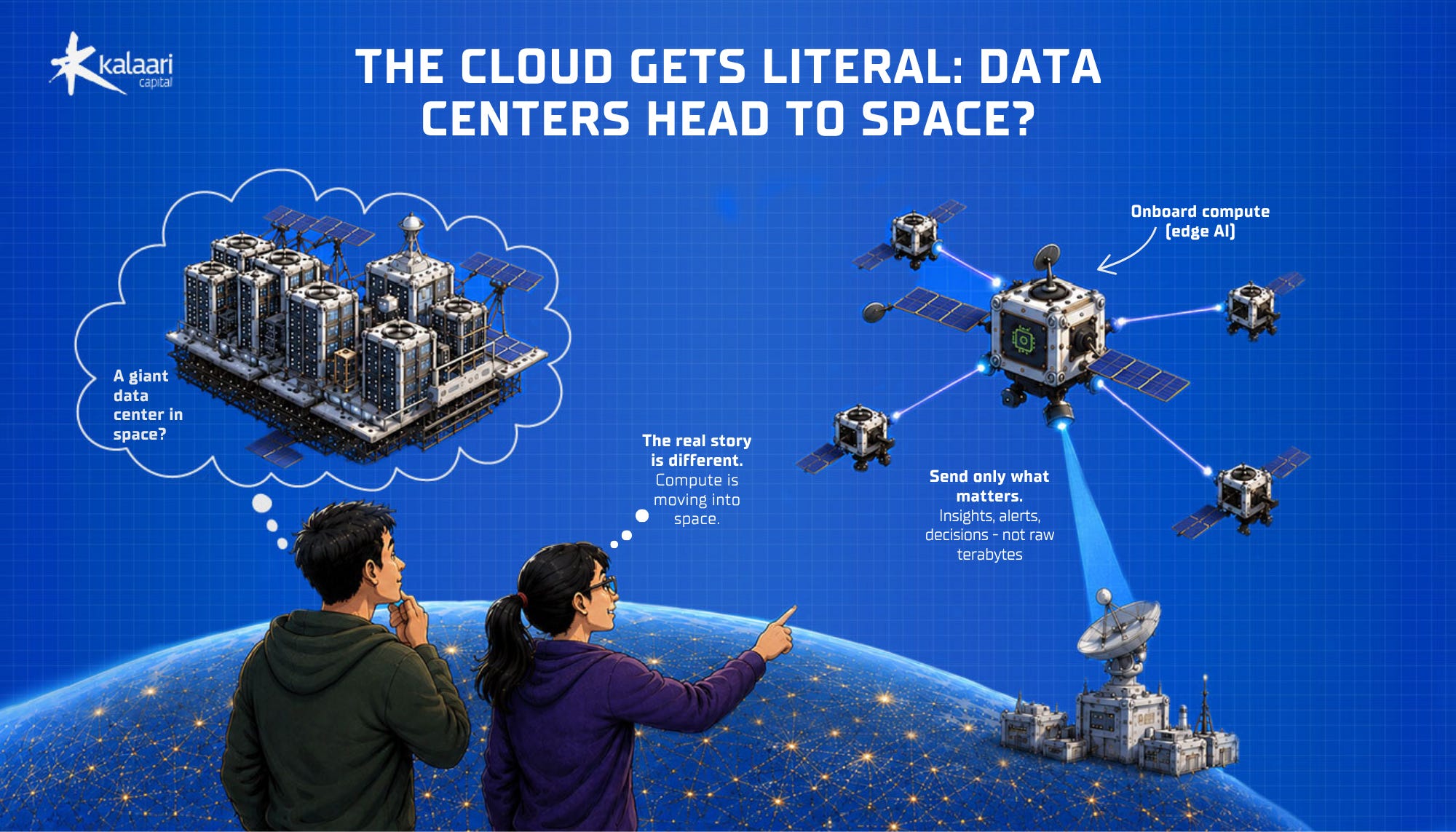
The world is in the middle of a data centre boom. Trillions of dollars are being committed to building the compute capacity AI needs, and in most major economies that build-out is running into the same wall: not enough power, not enough land, not enough grid capacity to keep up with demand.
That pressure has sparked a new and increasingly serious conversation - what if we simply built the data centres somewhere else? Somewhere with unlimited sunlight and no land constraints at all. Elon Musk has talked about “Gigafactories in space.” Google is testing AI accelerators on satellites. The idea has gone from science fiction to something being actively engineered.
It’s a great story. But that’s the headline, not the roadmap.
The compute going into orbit right now isn’t there to offload terrestrial workloads - it’s there because satellites are drowning in their own data and have nowhere fast enough to send it. Whether space eventually becomes a genuine extension of the terrestrial cloud is a much harder question, one that depends on launch economics, power density, and hardware that has to survive a decade with zero maintenance - and it’s still years from being answered either way.
So before we get to whether the world’s data centres end up in orbit, there’s a more immediate question worth answering: what is this compute actually for right now, and what does it take to build it? That’s what this edition decodes - the real demand pulling compute into space, and the stack required to meet it.
What Does In-Space Computing Actually Mean?
Satellites have had computers for decades. Those computers control the spacecraft, manage its power and thermal systems, process telemetry, execute commands and make sure the vehicle continues to operate correctly.
What is changing is the role that computation plays in the mission.
An increasingly capable satellite can run an AI model over an image, identify an object in a radar scene, detect an anomaly in an RF signal or decide whether another satellite should be tasked to investigate something it has detected. It can also host workloads that are unrelated to operating the spacecraft itself.
That is the essence of in-space computing: performing meaningful computation, storage, AI inference and eventually more general-purpose workloads onboard spacecraft or across connected spacecraft, rather than relying entirely on terrestrial infrastructure.
The satellite begins to behave less like a passive data-collection device and more like an edge-computing node.
That is the more immediate story behind the current interest in orbital compute.
Why Is Compute Moving Into Space?
There are two distinct arguments.
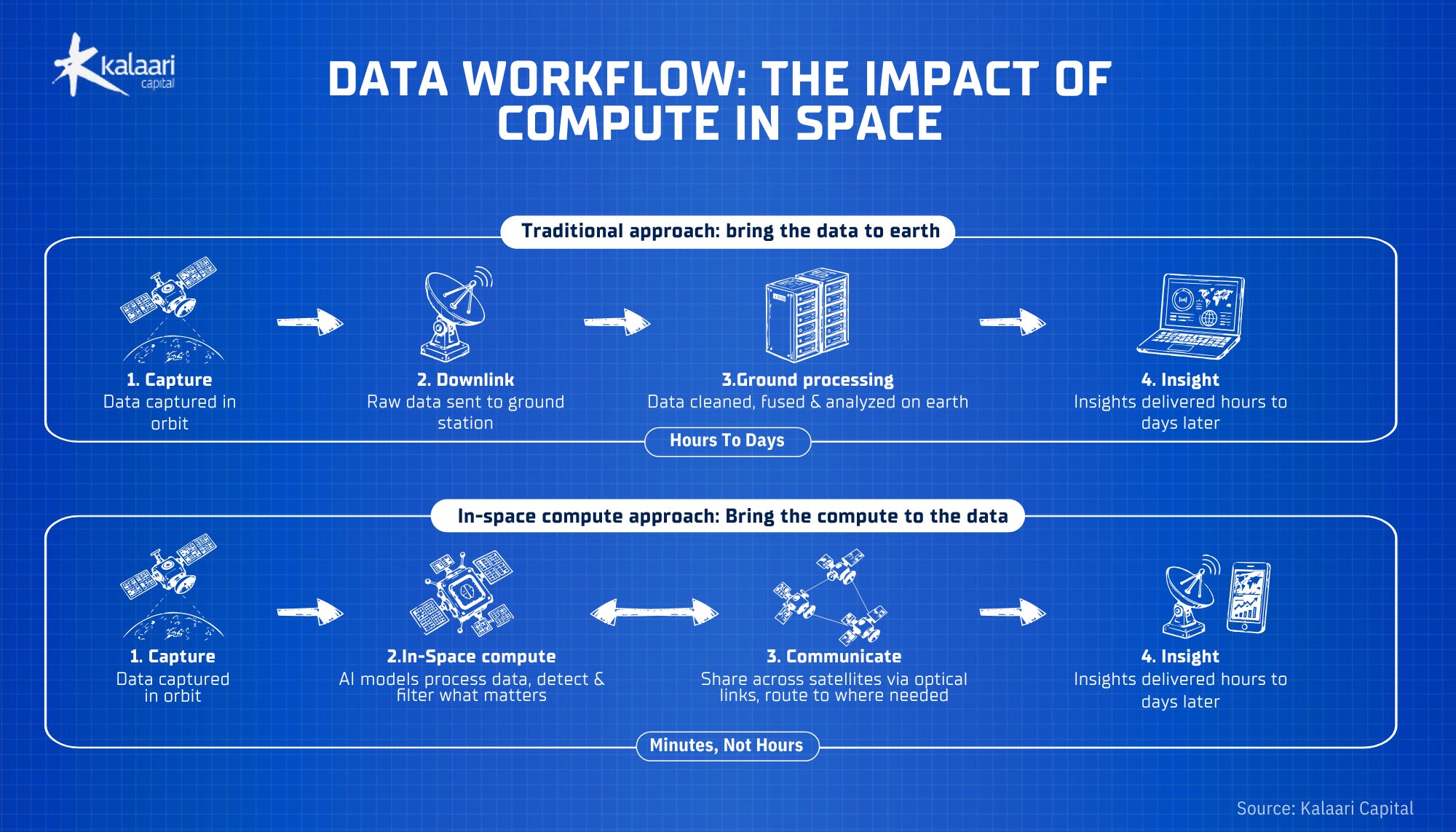
The first is about data proximity. Space-based sensors are producing increasingly large datasets, while communication capacity remains constrained. For applications where the value of an observation depends on speed, processing it in orbit can shorten the path from sensing to decision-making. A satellite can identify an event, prioritise the relevant data and potentially trigger another observation without first sending everything to Earth.
The second is about future compute infrastructure.
Terrestrial data centres increasingly require enormous amounts of electricity, grid capacity, land and cooling infrastructure. Space offers some unusual advantages: solar energy is available for much of an orbit, there is no land requirement and heat can be rejected directly through radiators rather than conventional cooling systems.
But these advantages come with a very different set of constraints. An orbital platform cannot simply draw more power from the grid, replace a failed server or upgrade its cooling system. Every watt, kilogram of hardware, square metre of radiator area and communication link has to be designed into the spacecraft before launch.
Space therefore does not eliminate infrastructure constraints. It changes them.
That is why the challenge is not simply putting a terrestrial accelerator on a satellite. It is designing a computing system around the physical realities of orbit.
AI in Space Is a Very Different Engineering Problem
It is tempting to think of this as a hardware problem: take a terrestrial accelerator, qualify it for space and put it on a satellite.
In practice, the processor is only one part of the architecture.
A more powerful processor consumes more electricity. More electricity eventually becomes heat. More heat requires a larger thermal system. A larger thermal system adds mass and structural complexity. More mass affects launch economics. Larger solar arrays can provide more power but can also alter spacecraft dynamics and make precision pointing more difficult. And if the spacecraft is expected to communicate through a narrow optical beam, even small pointing errors can become a communications problem.
The compute architecture therefore has to be designed together with the spacecraft rather than bolted onto it afterwards.
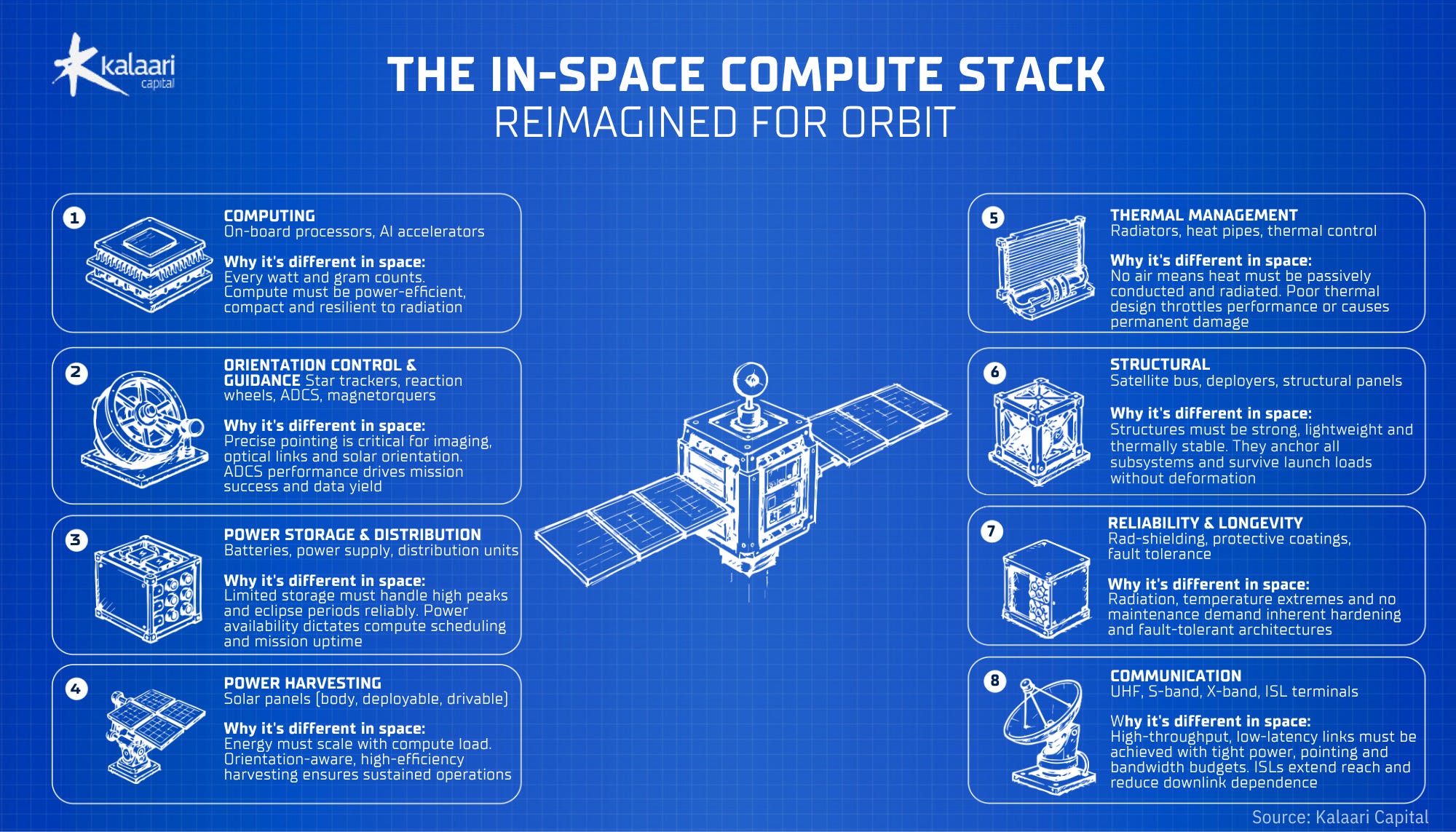
Compute
Peak performance is not necessarily the right metric in orbit. A processor competes for power, thermal capacity, mass and volume with every other spacecraft subsystem.
It is therefore about how much useful computation can be extracted from those constraints. Some workloads may justify high-performance accelerators, while others are better suited to lower-power inference processors, FPGAs or radiation-tolerant CPUs. Training and inference also have very different requirements.
NVIDIA’s move into space computing reflects this range, with its stack spanning edge platforms such as Jetson through to much more capable systems designed for demanding orbital workloads.
The opportunity is therefore not simply faster processors, but compute architectures optimised for performance per watt, radiation tolerance, memory bandwidth and mission lifetime.
Radiation
Radiation is one of the clearest differences between terrestrial and orbital computing.
Space radiation can cause transient errors, memory corruption and long-term degradation of electronics.
There are three broad ways of approaching it.
One is to use radiation-hardened components that are specifically designed for the environment. These offer high reliability but generally involve a significant performance and cost trade-off compared with commercial silicon.
Another is to use commercial components and provide sufficient shielding and system-level protection around them. This can offer dramatically better computing performance and economics, but shifts more of the burden onto spacecraft design.
The third layer is software. Error detection, memory scrubbing, redundancy, checkpointing and graceful degradation can allow a system to continue operating even when individual computational elements experience faults.
The interesting architectures will likely combine all three, deciding where to place the reliability burden between the silicon, spacecraft and software.
Thermal management
Thermal management is one of the least intuitive aspects of space computing because space itself is extreme with temperature sway (-150 degrees celsius to +120 degrees celsius), but cooling a computer in vacuum is difficult because there is no air to carry heat away. Heat has to be conducted through the spacecraft and ultimately rejected through radiators.
As compute density rises, radiator capacity becomes a limiting factor. More processing means more power and therefore more heat, which can require larger and heavier thermal systems.
Compute density is consequently constrained not just by the processor, but by how efficiently the spacecraft can move and reject its heat.
Power
An orbital computer has to generate the energy it consumes.
Solar arrays provide the primary source, but they add mass and structural complexity, while batteries are required during eclipse periods. This makes the compute workload part of the spacecraft’s power architecture.
A platform running continuous inference will have different requirements from one that schedules workloads around available solar power. Power-management systems that dynamically allocate compute according to the spacecraft’s energy state could therefore become increasingly important.
Memory and storage
Compute is useful only if data can reach the processor fast enough.
High-resolution sensors can generate large data streams that need to be corrected, filtered and processed before inference. This makes the entire path from sensor to memory, accelerator, storage and communications important.
Future spacecraft will therefore increasingly need to be designed around the data pipeline rather than treating compute as a standalone payload.
Pointing and ADCS
One of the less obvious constraints on orbital computing is the attitude-determination and control system, or ADCS.
Pointing becomes important when the spacecraft is expected to combine sensing, autonomous decision-making and high-capacity communications.
Consider an optical inter-satellite link. The two spacecraft need to identify one another, acquire the link and maintain a very narrow beam while both are travelling at several kilometres per second. A small pointing error can be enough to break the connection.
The same issue arises in high-resolution Earth observation. If an onboard AI model detects something interesting and the spacecraft needs to retask its sensor rapidly, the spacecraft needs to know exactly where it is and where the target is. The ability to compute a decision quickly is only valuable if the spacecraft can physically respond to that decision.
ADCS also determines how effectively solar panels can be oriented towards the Sun, directly affecting the energy available to power compute-intensive workloads.
Star trackers, gyroscopes, reaction wheels, actuators and the software controlling them therefore become part of the broader computing architecture. Better compute increases the value of rapid retargeting and autonomous communication, while better pointing determines how effectively that compute can be translated into physical action.
Structural stability
Compute-heavy spacecraft may require larger solar arrays, radiators, power systems and communication terminals, all of which alter mass distribution and structural dynamics.
That matters because structural deformation and vibration can translate into pointing errors, particularly for high-resolution sensors and optical communication systems.
As compute density increases, structure, thermal management, power and pointing increasingly have to be designed as one integrated system.
Communication
A satellite that can process its own data locally is useful. A network of satellites that can exchange data and computation is much more powerful.
The most obvious architecture is still satellite-to-ground communication, but high-capacity optical inter-satellite links allow one satellite to process information, another to provide an additional observation and a third to relay the result to Earth.
But maintaining these links requires extremely precise pointing, acquisition and tracking between rapidly moving spacecraft.
Communication therefore becomes more than a way to send data home. It becomes the network connecting the orbital compute layer.
What Does In-Space Computing Unlock?
The strongest applications are those where processing data in space materially changes the speed, economics or control of the mission.
Earth observation could move from selling imagery to selling intelligence
EO is likely to be one of the clearest early markets.
Today, the typical model is satellite → imagery → downlink → processing → analytics → customer. In-space computing can move part of that processing onto the satellite itself.
Instead of buying imagery, a customer could task a satellite to answer a specific question: identify new construction, detect vessels of a certain type or flag changes in a particular region.
This opens the possibility of moving from data-centric pricing towards task- or compute-centric models, where customers pay for a particular analysis rather than primarily for the underlying pixels.
The satellite becomes a programmable sensing platform, with compute becoming part of the product rather than merely part of the infrastructure.
Defence is about sovereignty, autonomy and control of the intelligence loop
For defence, the value extends beyond faster AI inference. It is about owning the sensing and intelligence infrastructure itself.
A sovereign asset can be tasked according to an evolving operational requirement, process sensitive information onboard and return intelligence without sending every raw observation through an external terrestrial infrastructure.
The resulting loop becomes much tighter: task the asset, collect the information, process it and retask based on what it discovers.
For ISR, that combination of sovereignty, autonomy and control over tasking can matter more than the underlying cost of compute.
The value proposition for defence is therefore unlikely to be expressed purely in terms of compute cost. It is about control over the asset, autonomy in the intelligence process and the ability to operate a sensing system that can respond to changing requirements without depending on a long terrestrial processing chain.
Deep-space missions have an even stronger reason to compute locally
As spacecraft move farther from Earth, communication delays increase and bandwidth becomes more constrained. A spacecraft cannot rely on the ground for every decision.
Onboard computing allows it to interpret its environment, prioritise observations and respond to unexpected situations without waiting for instructions from Earth.
Here, local intelligence is less an optimisation than a prerequisite for meaningful autonomy.
What Could Make In-Space Computing Difficult to Scale?
The first challenge is economics.
Orbital compute carries the cost of launch, spacecraft manufacturing, power generation, thermal systems, communications and hardware that cannot easily be replaced. Terrestrial computing remains far cheaper for workloads that have no reason to be in space.
That means early orbital compute is likely to make sense where the value of being in space is high: reducing latency to space-generated data, reducing downlink requirements, enabling autonomy or providing sovereign infrastructure.
The second challenge is hardware lifetime.
A terrestrial data centre can replace a failed server or upgrade to a new generation of accelerators. An orbital platform cannot. The hardware launched today may need to remain useful for years while facing radiation, component degradation and rapidly improving terrestrial technology.
This makes modularity, redundancy, graceful degradation and software-defined recovery much more valuable in orbit. The system has to be designed not simply for its performance on launch day, but for how useful that performance remains throughout the mission.
Where Could Startups Build?
As in-space computing scales, the opportunity for startups is likely to emerge across multiple layers of the stack.
1. Compute-as-a-Service: vertically integrated platforms
The first opportunity is to build an integrated orbital compute platform and offer it as a service. Unlike terrestrial cloud infrastructure, orbital compute requires the provider to solve for the spacecraft, processors, power, thermal management, communications and software together. Early players may therefore need to own much of this stack in-house rather than simply providing a software layer on top of third-party infrastructure.
The customer experience, however, could look much simpler. A user uploads a model, defines a workload and specifies the data or task; the platform handles where and when the computation runs, accounting for available compute, power, thermal and communication constraints. This could turn orbital compute from a spacecraft capability into an infrastructure service.
2. Optical communications: the network behind the compute
As compute spreads across multiple spacecraft, those nodes need to exchange data efficiently. High-capacity optical inter-satellite links could become a critical layer, supported by precision pointing and tracking, link-acquisition systems and optical ground infrastructure.
The opportunity is therefore broader than building optical terminals. It is about creating the network that allows compute nodes to communicate reliably across orbit and with the ground.
3. Critical subsystems: the picks and shovels
The third opportunity lies in the components that determine how much compute can actually operate in space. Radiation protection, fault-tolerant computing, high-density power generation and storage, thermal management, precision ADCS and space-optimised compute hardware will all become increasingly important as compute density rises.
These businesses do not need to predict which orbital compute platform will ultimately win. If the category scales, every platform will face the same underlying constraints. For startups, that creates an opportunity to become a critical supplier to multiple orbital compute architectures without having to own the entire stack.
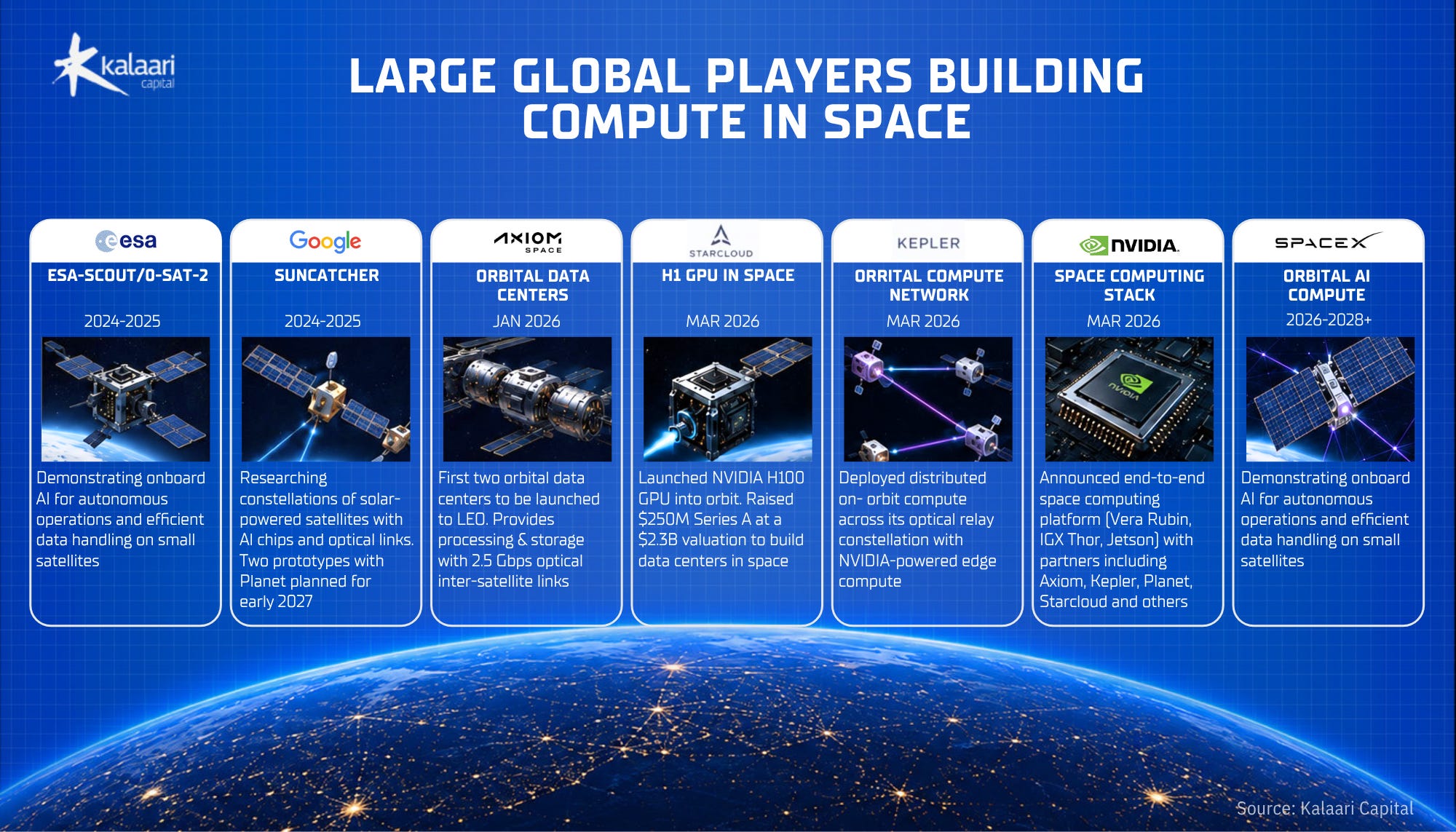
We are already seeing the first pieces of that architecture emerge: onboard AI processors, radiation-tolerant accelerators, optical inter-satellite links, distributed compute nodes, orbital storage and software platforms for deploying workloads in space. The recent activity from Google, NVIDIA, Axiom, Kepler, ESA and startups such as Starcloud and TakeMe2Space suggests that the ecosystem is moving from isolated demonstrations toward an emerging infrastructure stack.
The biggest opportunity may not be in building a giant data center above Earth.
It may be in building the compute layer that makes the entire orbital ecosystem more capable.
And if that layer scales - if launch costs continue falling, compute becomes more power-efficient, radiation and thermal constraints are solved, and orbital networks become increasingly connected - the eventual destination could be much larger:
A distributed computing infrastructure in orbit, and eventually dedicated orbital data centers operating as an extension of the terrestrial cloud.
But the near-term opportunity is much simpler.
The data is already in space. The next question is whether the intelligence should be there too.
If you are building in space computing, orbital AI infrastructure, radiation-tolerant compute, inter-satellite networking, or applications that turn space-generated data into real-time intelligence - we want to hear from you.
Write to us at deeptech@kalaari.com.