


At 11:46 am on 6 July 2026, solar, wind, hydro and nuclear plants together met 50.02% of India’s electricity demand of 221.5 GW. It was the second year in a row that clean sources had crossed half of national demand at a point in the day, following a similar moment in July 2025, and it reflected how far India’s energy ecosystem has moved. India now has more than 300 GW of non-fossil generation capacity, over half of everything installed.
That moment came close to noon, when solar output is strongest. As the afternoon wore on and solar generation fell away, demand did not fall with it. Lights, fans and air conditioners came on through the evening, and the shortfall was met largely by coal plants ramping up. Over the course of the day the country produced a large amount of clean electricity, but it had very little ability to hold any of it for the hours when it was needed most.
Demand is also growing and becoming harder to serve: peak demand crossed 250 GW for the first time in May 2024 and reached a record 270.8 GW in May 2026, both set during summer heat when cooling loads are at their highest, while industrial electrification, electric vehicles and data centres keep adding loads with daily patterns of their own. Meeting this demand is no longer only a question of producing enough electricity over a day or a year. The system has to deliver it in the hours when demand is highest.
On the supply side, as more of India’s electricity comes from the sun and the wind, the grid has less control over when it is generated. Solar output follows the sun, and wind generation follows weather and seasonal wind patterns, strongest during the monsoon months, rather than the daily rhythm of demand. Output can also swing within minutes as clouds pass or winds shift, which makes renewables a far more erratic source of generation that the grid has to balance in real time.
This gap between when clean electricity is produced and when it is needed, and how steadily it arrives, is one of the largest unresolved problems in India’s renewable energy story.
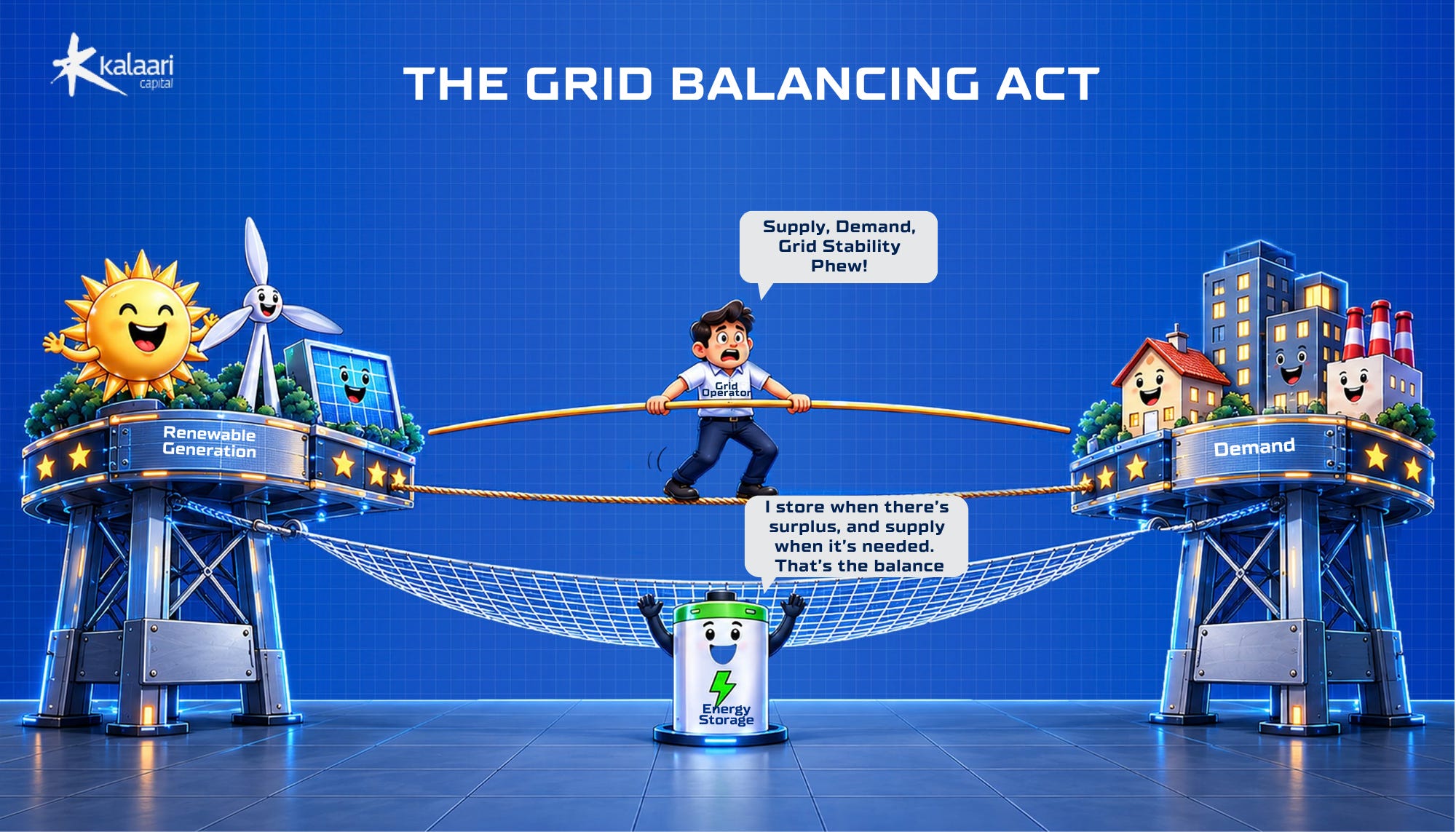
For most of its history, the grid has balanced supply and demand by adjusting generation and moving power across regions through transmission lines. A grid built increasingly on renewables needs another kind of flexibility: the ability to hold clean electricity when it is plentiful, release it steadily when output swings and deliver it during the hours of peak demand, which is the role energy storage is being built to play. Transmission moves electricity across geography; storage moves it across time, from the hours when it is abundant to the hours when it is scarce.
This edition looks at what Energy storage involves: what we are asking storage to do, which technologies fit which jobs, why storing energy for days remains unsolved, and where in the storage stack the next generation of companies could be built.
What are we asking storage to do?
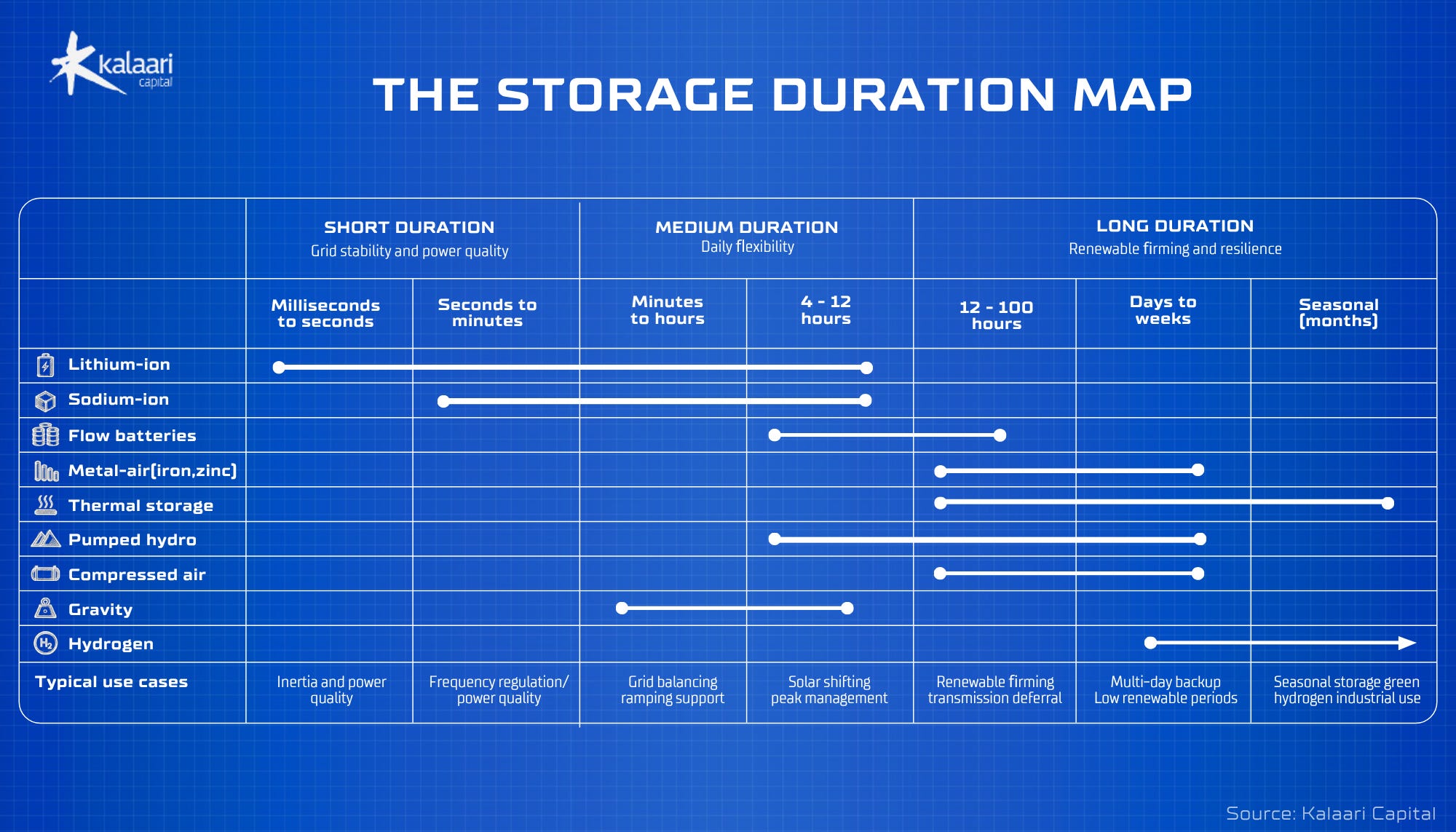
Storage is being asked to solve three different problems on the grid, and they play out over very different timescales.
Seconds to minutes: keeping the grid steady. When cloud moves across a solar park or the wind drops, output can fall within minutes, and the grid has to make up the difference almost instantly to keep supply and demand in balance. Storage for this job needs to respond in fractions of a second and deliver a burst of power, but only for a short time. How fast it reacts matters more than how much energy it holds.
Hours: moving solar into the evening. This is the problem behind the 6 July milestone. Surplus solar at midday, which would otherwise be curtailed, has to be held for a few hours and released into the evening peak. Storage for this job typically runs for two to four hours and cycles every day, so cost per cycle and lifetime matter most. It is also what most of India’s current storage tenders are buying.
Days: riding through weak wind and cloud. At times the grid faces several days of low renewable output, during a run of still, overcast weather. Storage for this job has to hold very large amounts of energy and may sit unused for weeks in between, so the cost of storing each unit of energy matters far more than speed or efficiency. It is the hardest of the three to solve economically.
Each of these jobs balances power, energy, speed and cost differently, so storage is less a single product than a family of solutions. Delivering each one can call for a different combination of chemistry, hardware and software, from fast-acting batteries and power electronics that steady the grid, to daily-cycling systems built for low cost per cycle, to very cheap, energy-heavy systems that can hold power for days.
How storage is measured
Power (MW) is how quickly a system can charge or discharge. Energy capacity (MWh) is how much it can hold. Together they set duration: a 100 MW system with 400 MWh can run at full power for four hours.
Round-trip efficiency is how much of the stored energy comes back out. Cycle life is how performance holds up over thousands of charge-discharge cycles. Response time is how quickly the system reacts to a grid event. Energy density is how much energy fits into a given weight or volume, which matters far more in a car than in a container beside a solar park.
Cost per kWh alone rarely settles the question. The economics depend on how these characteristics combine with how often the asset is actually used.
Why now?
Three shifts have moved storage from a niche to the centre of power planning.
The first is cost. Lithium-ion battery pack prices fell to an average of $108/kWh in 2025, more than 90% below 2010 levels. Packs for stationary storage fell further, to around $70/kWh, a 45% drop in a single year that made grid storage the cheapest battery segment for the first time. Much of this reflects overcapacity in China, where cell production for stationary storage in 2025 was more than double global installations, along with the shift toward lithium iron phosphate (LFP) chemistry.
The second is procurement. India floated around 69 storage tenders totalling roughly 102 GWh in 2025, backed by a ₹5,400 crore viability gap funding scheme for 30 GWh of standalone battery storage. Prices discovered in these auctions have fallen quickly. A Rajasthan tender for 500 MW / 2,000 MWh closed at ₹2.85 lakh per MW per month for a four-hour system, down from ₹4.44 lakh in earlier rounds.
The third is how storage earns money. Depending on market design and contracts, the same battery can earn from shifting cheap daytime power into the evening, providing capacity during peaks, stabilising grid frequency, deferring upgrades to transmission and distribution networks, and keeping critical facilities running during outages. As these revenue streams open up, storage starts to look less like a cost to be justified and more like infrastructure that can be financed.
Lithium and beyond
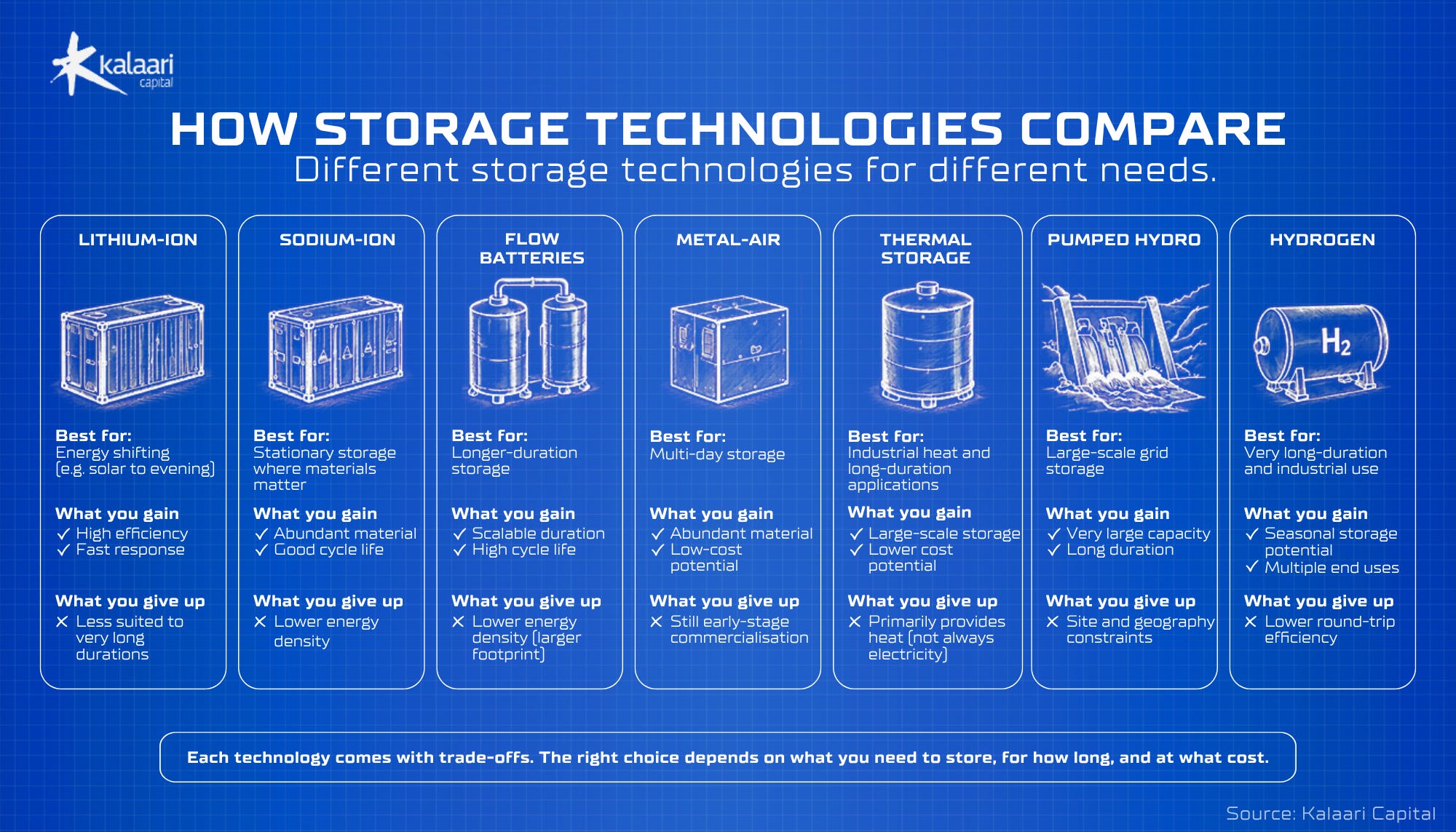
Lithium-ion is where almost every grid storage project starts today, but a grid battery has different priorities from an electric vehicle. It does not need to fit inside a car and can sit in a container next to a solar plant, which shifts the weighting away from energy density and toward cost, duration, safety, material availability and lifetime, and has opened space for a wider set of technologies.
Lithium-ion: the workhorse of grid storage today
Lithium-ion makes it possible to deploy storage quickly, at scale and at steadily falling cost, which is why it carries the large majority of grid batteries being built today. For stationary use the industry has largely moved to lithium iron phosphate (LFP), which gives up some energy density in exchange for lower cost, longer cycle life and better thermal safety than the nickel-based chemistries common in vehicles. Its limits show up at longer durations, where every additional hour means proportionally more battery, and in its supply chain, where cell manufacturing is heavily concentrated in China.
Sodium-ion: storage without lithium supply chains
Sodium-ion batteries offer a way to build electrochemical storage from one of the most abundant elements available, reducing exposure to lithium supply and price swings. They store less energy per kilogram than many lithium-ion configurations, which limits them in vehicles but makes them suitable for stationary system where footprint is rarely the binding constraint.
Long-duration storage: holding energy for days
Lithium-ion and sodium-ion are well suited to jobs measured in hours. Covering several days of weak wind and cloud is a different problem. A 100 MW system needs 400 MWh of capacity to run for four hours and 10,000 MWh to run for 100 hours. The power requirement is unchanged, but the energy that must be stored grows twenty-five times, and for lithium-ion that means buying proportionally more battery until the economics stop working. Long-duration energy storage (LDES) technologies make a different trade, accepting lower efficiency or lower energy density in exchange for storing very large amounts of energy cheaply.
The economics are as hard as the engineering. A four-hour battery may cycle almost every day and earn revenue each time, while a system built for a multi-day shortfall may sit idle for weeks and become valuable only in the periods the grid most fears. Whether such assets get built depends on whether markets and procurement contracts pay for that capacity being available, not only for the energy it delivers. Several families of technology are competing to make that capability reliable and financeable.
Flow batteries store energy in liquid electrolytes held in external tanks, so duration can be extended by adding larger tanks rather than proportionally more power hardware. The vanadium redox flow battery (VRFB) is the most established design, and newer chemistries based on iron, zinc and organic electrolytes aim to cut the cost of the electrolyte itself. The trade-off is a larger footprint and lower energy density. Delectrik, an Indian startup makes VRFB batteries with products ranging from 10kWh (residential) to >10MWh (utility).
Metal-air batteries aim to store very large amounts of energy using cheap, abundant metals and oxygen drawn from the air. Form Energy in the US is the most visible example. Its iron-air battery works on reversible rusting, converting iron to rust as it discharges and back again as it charges, and is designed to deliver power for around 100 hours. The company is rolling out its first commercial system with US utilities, including a 15 MW/1500 MWh project for Georgia Power.
Zinc-based batteries pursue low cost with non-flammable chemistries suited to stationary use. In India, Offgrid Energy Labs, spun out of IIT Kanpur, has developed a zinc-bromine battery for stationary storage, raised a $15 million Series A in 2025 and opened a 10 MWh pilot manufacturing line in the UK in July 2026.
Thermal storage serves users whose final need is heat rather than electricity. A plant can use electricity when it is cheap, store it as heat in molten salts, bricks or other engineered media, and release it when a process requires it, avoiding the losses of converting back into electricity.
Mechanical storage works through physical change: pumped hydro lifts water to a higher reservoir, compressed air systems hold pressurised air underground or in vessels, and gravity systems raise heavy masses and recover energy as they descend. Where suitable sites exist, these deliver large volumes of energy over long durations, with geography, land, construction time and capital as the main constraints. Pumped hydro is expected to provide much of India’s planned storage outside batteries.
Hydrogen produced with electricity can be stored and later used as a fuel or converted back into power. Its round-trip efficiency is well below that of batteries, so its case rests on storage over weeks or seasons, or on applications where hydrogen itself has value as an industrial fuel or feedstock.
For most of these technologies, the challenge is less the underlying science than the step from promising pilots to reliable systems operating at commercial scale.
From battery to power plant: the storage system
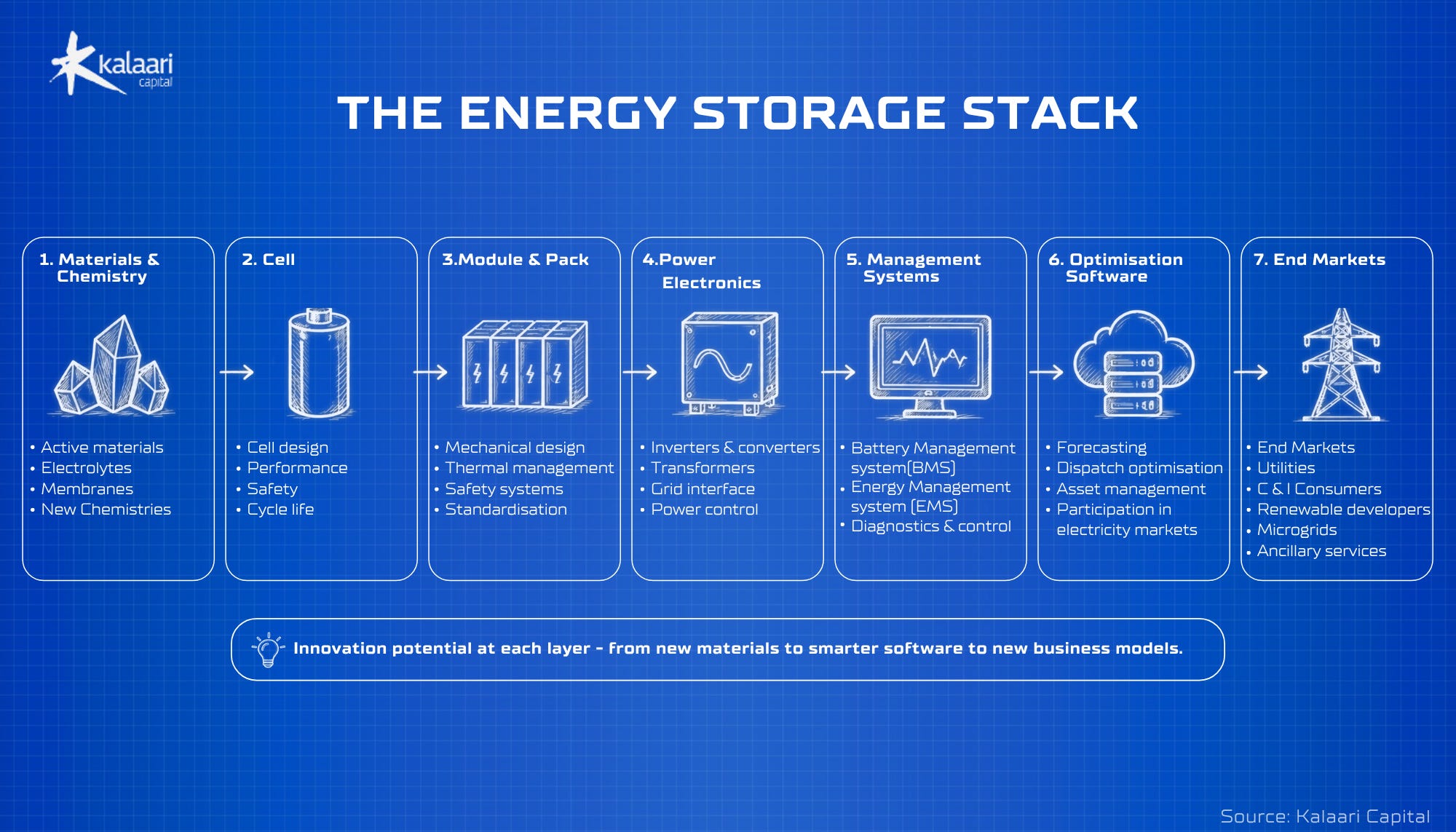
The chemistry inside a storage project attracts most of the attention, but a grid-scale installation increasingly resembles a power plant. Cells are assembled into modules, packs and containers, connected through inverters and transformers to the grid, and surrounded by cooling, sensing, fire safety and control systems.
The intelligence layer sits above this hardware. A battery management system tracks voltage, temperature, state of charge and degradation in each cell. Power electronics convert electricity between the storage system and the grid. An energy management system decides when to charge and discharge, and optimisation software increasingly decides how the asset earns its money, whether by serving a solar plant, a factory’s peak load, the grid operator, or several of these at once. Seen end to end, the stack runs from materials and chemistry through cells, system hardware and power electronics to management software, optimisation and energy markets.
This matters for where value accrues. Alongside the cell itself, a growing share of value sits in the layers that determine how safely, efficiently and profitably an asset operates over fifteen or twenty years, particularly as lithium-ion cells become a commodity with prices set largely by Chinese overcapacity.
What kind of storage does India need?
India’s storage requirement is large and specific. The Central Electricity Authority estimates the country will need 411.4 GWh of storage by 2031–32, more than 236 GWh of it from batteries and much of the rest from pumped hydro, rising to around 888 GWh by 2035–36. Against that, commissioned battery storage stood at well under 1 GWh at the end of 2025. Tenders and funding are now in place, and the gap lies in building, connecting and operating projects at scale.
The use cases are shaped by how India’s grid is evolving.
Shifting solar into the evening is the largest and most immediate need, and it is what most current utility tenders are buying: four-hour systems that charge at midday and discharge into the evening peak.
Large consumers such as factories, commercial buildings and data centres are adding storage behind the meter to manage peak charges and protect against outages. For data centres in particular, battery systems that once served only as backup can also provide power-quality management and peak shaving, turning a cost centre into a working asset.
Telecom and distributed backup across India’s large network of tower sites still relies heavily on diesel generators and lead-acid batteries, an installed base where lower-cost, longer-life storage can displace fuel.
Industrial heat accounts for a significant share of industrial energy use, and thermal storage allows plants to electrify process heat using cheaper daytime power.
Second-life batteries from India’s fast-growing electric two and three-wheeler fleets will become a meaningful resource for less demanding stationary applications as those packs reach the end of their vehicle life.
Weak-grid and remote locations need storage paired with solar to make microgrids reliable, where the value lies less in arbitrage than in keeping supply steady.
Beneath all of these sits a supply-chain question. Most of the cells going into India’s storage projects today are imported, largely from China. Domestic cell manufacturing is being built up under the production-linked incentive scheme for advanced chemistry cells, but for now the buildout depends on a supply chain India does not control. That creates room for alternative chemistries built on locally available materials, and for Indian companies in the layers of the stack that sit above the cell.
Where could the next storage companies emerge?
The opportunity runs across the full stack, from the materials and chemistry inside the cell to the software that decides how an asset earns. At the cell level, companies working on sodium-ion, zinc-based, iron-based and other chemistries can target combinations of cost, safety, duration and material availability that lithium-ion does not address well, and for India they also offer a route to storage built on locally available materials rather than imported cells. Long-duration storage could become a new category of grid infrastructure if technologies can deliver many hours or days of storage at a viable cost and markets learn to pay for it.
Above the cell, a growing share of value sits in the layers that decide how an asset performs and earns over its life.
Power electronics become more important as storage assets connect to the grid and manage more complex power flows.
Battery intelligence, including diagnostics, degradation modelling and predictive maintenance, determines whether a fleet of assets delivers on its warranty and its financial model over fifteen or more years.
Storage optimisation and trading software decides whether a battery should be serving a solar plant, a factory’s peak, the grid operator or all three, and captures the stacked revenue that makes storage financeable.
Lifecycle businesses in testing, refurbishment, second-life deployment and recycling will grow alongside the installed base, with companies such as Lohum already building around recovering value from used batteries.
Storage-as-a-service for commercial and industrial customers can change who owns the asset altogether, letting a factory or data centre buy reliable power and lower peak charges without buying a battery.
The opportunity lies both in building better ways to store energy and in the systems, software and services that make stored energy dependable and valuable, in a market that is preparing to add hundreds of gigawatt-hours.
Making clean electricity available when it matters
India’s energy transition has so far been measured mostly in generation capacity, and on that measure it has moved faster than its own targets. The next phase will be measured by how much of that clean electricity can be made available in the evening peak, through a week of weak wind, or at a data centre when the grid falters. The technologies for doing this will differ by problem, and that diversity is what creates room for new companies across chemistry, materials, power electronics, software, system engineering and energy markets.
If you are building in energy storage, from new chemistries and long-duration systems to power electronics, battery intelligence, storage optimisation or storage-as-a-service, we want to hear from you.
Write to us at deeptech@kalaari.com.